

Generative Engine Optimisation (GEO) and the Future of Holiday Rentals in Australia

The search revolution has already begun
When travellers plan their next holiday, they are no longer just typing “Byron Bay holiday home” into Google. Increasingly, they are asking ChatGPT, Gemini, or other AI tools for inspiration. A traveller might say, “Find me a beachfront house in Byron that’s family-friendly and has a pool.”
The response is no longer a list of blue links. It is an AI-generated summary that curates, filters, and recommends properties directly. This shift is changing how every business in tourism and accommodation gets discovered.
Welcome to the era of Generative Engine Optimisation (GEO), the next evolution of digital visibility.
For holiday rental managers, understanding GEO is not just about staying relevant. It is about staying visible in a world where traditional SEO alone is no longer enough.
What is Generative Engine Optimisation (GEO)?
Just as Search Engine Optimisation (SEO) helped businesses appear on Google, Generative Engine Optimisation focuses on making your brand and listings discoverable within AI-generated results.
When travellers use tools like ChatGPT, Gemini, or Perplexity to plan their trip, those systems draw from a wide range of online data to produce their answers: your website, listings, reviews, social channels, and structured metadata.
The goal is no longer simply to rank on Google. The goal is to make sure your brand and properties are referenced by AI when someone asks for accommodation in your region.
While definitions are still varying and the specific name of this field has a few schools of thought (AEO – Answer Engine Optimisation – is another popular term), GEO helps you become part of the conversation inside AI-driven discovery, where the guest journey increasingly begins.
The rise of zero-click search
One of the biggest shifts in this new search landscape is the rise of zero-click results. This is when a user’s question is answered directly within a search result or AI summary, without ever visiting a website.
Similarweb reported that ~80% of searches that trigger AI Overviews end without a click (a classic “zero-click” outcome), while overall zero-click searches across Google rose from 56% to 69% year-over-year
Google started this trend with featured snippets and “People also ask” sections many years ago. Generative AI takes it much further by summarising and combining data from across the web.
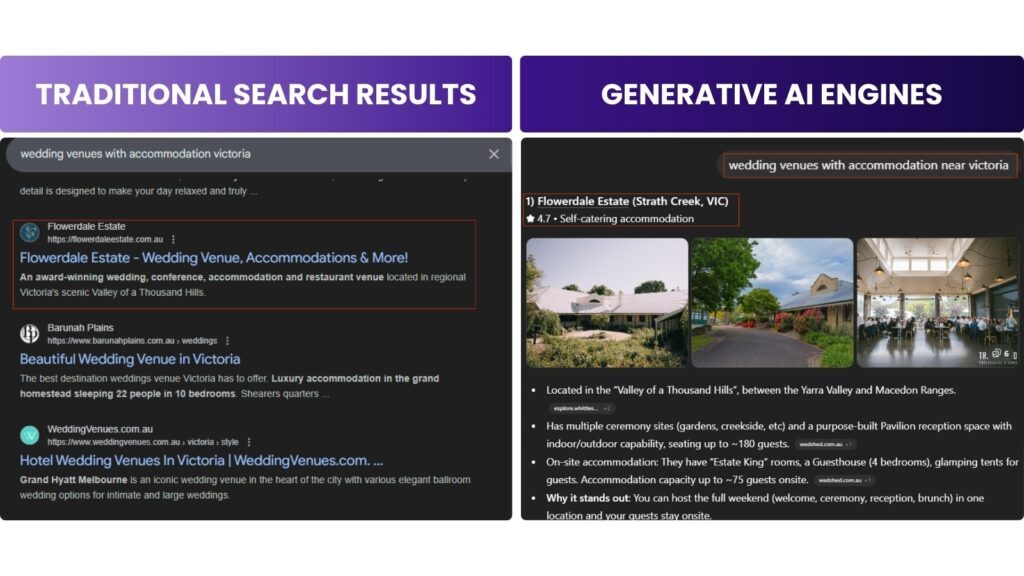
For property managers, this means that if a traveller asks, “What are the best family holiday homes in Noosa?”, they may never reach your website unless your brand is already part of that AI-generated response.
In a zero-click world, visibility is not about ranking high on a search results page. It is about being represented accurately and confidently within the AI’s own recommendations.
Changing guest behaviour and multi-touch bookings
Today’s travellers are using more tools than ever to research and book accommodation. 18% of 25–34-year-olds already use tools like ChatGPT for holiday inspiration, and ~2 in 5 say they’d be confident letting AI book for them.
They might begin with an AI tool to narrow down locations, move to an OTA to compare options, check Google or Airbnb reviews, then visit a brand’s direct booking website once they feel confident enough to book.
This multi-touch journey means every digital impression counts. GEO influences each of these moments by ensuring your brand is visible, credible, and consistent across platforms.
It also connects strongly to the growing trend toward direct bookings. More travellers are realising that booking directly can mean better service, clearer communication, and very often better pricing.
That’s why GEO requires a multi-layered approach:
- Technical optimisation to ensure your site is crawlable, chunkable, structured and speed optimised.
- Content optimisation to provide the detailed, contextual information AI tools can interpret and repurpose.
- Off-page signals through backlinks, citations, and brand mentions that prove authority and authenticity.
By investing in structured data, useful content, and direct booking visibility, managers can ensure that AI tools reference their websites directly, ultimately helping them own more of the booking relationship.
Property managers and owners are evolving too
Owners are becoming more discerning about who manages their property. They expect their chosen property management company to have a clear digital strategy, not only across OTAs but also in emerging discovery platforms.
Generative Engine Optimisation is becoming a differentiator in owner pitches. It shows that your business is forward-thinking and ready for the next phase of search.
A property manager who can say, “We are preparing your property to appear in AI travel searches,” immediately stands apart. It communicates that you are not only focused on bookings today but also protecting their property’s long-term visibility in the market.
Case study: L’Abode Accommodation – premium positioning through digital strength
L’Abode Accommodation is a leading accommodation provider, specialising in executive and holiday property management. Founded by Lisa Peaterson over 13 2 years ago, L’Abode Accommodation has experienced consistent growth and success which is grounded in attention to detail both on and offline.
Behind the scenes, their success comes from a disciplined approach to technical SEO, structured data, and off-page authority.
Every L’Abode property page is technically optimised using structured schema data that helps search engines and AI systems identify details like property type, location, amenities, and price range. Their website architecture is fast, secure, and mobile-optimised, which increases indexation and strengthens their authority across search platforms.
Beyond on-page optimisation, L’Abode has built a high-quality off-page network through features on tourism platforms, local media, and partner collaborations. This off-page authority tells both search engines and AI tools that the brand is established and trustworthy.
Their content strategy is equally refined. L’Abode produces local guides, neighbourhood spotlights, and lifestyle blogs that connect each property to the experience of staying there. This gives AI systems richer context when generating recommendations – linking the brand not just to “accommodation,” but to luxury experiences and desirable Sydney suburbs.
These combined efforts have produced tangible results. L’Abode has not only grown its direct booking traffic but has also expanded its property portfolio by attracting investors seeking premium property management. Many new owners discovered L’Abode online while researching high-end managers in Sydney, a visibility made possible through their technical optimisation and GEO-focused approach.
This demonstrates how a solid digital foundation can drive both guest acquisition and business growth.
Case study: Holidays Collection – a masterclass in multi-channel discovery
The Holidays Collection manages properties across the NSW South Coast and Southern Highlands, and has long prioritised digital structure and search integrity as part of its growth strategy.
Their team, in collaboration with marketing partners, ensures every listing is correctly tagged with schema markup that describes property attributes, region, and key features. Pages load quickly, metadata is consistent, and structured URLs help AI systems link each property to its destination and traveller intent.
This technical discipline is matched with strong off-page SEO. The Holidays Collection maintains verified listings local tourism directories and partner websites, all feeding consistent information about their brand and properties. This digital consistency is exactly what AI engines look for when building confidence in their search outputs.
They also invest in strategic content production, including travel articles, regional guides, and seasonal promotions that help position them as local experts. Each piece of content reinforces their authority for destination-specific searches, improving the likelihood of inclusion in AI-generated travel summaries.
The outcome is an integrated digital footprint that supports both direct bookings and long-term GEO readiness. The Holidays Collection has positioned itself not only as a property management company but as a trusted information source for regional travel, a role that aligns perfectly with how AI search interprets authority and expertise.
Why the future looks bright for Australian property managers
While GEO may seem like a technical challenge, it actually presents a major opportunity, especially in the Australian market. Read on further below to see why:
- Australia’s domestic tourism base is strong. Local demand remains high, giving managers room to innovate and test new approaches to digital discovery.
- GEO is a game-changer for SMEs and Local Businesses. AI search levels the playing field. Generative engines do not just favour the biggest brands. They prioritise relevance, reliability, and well-structured information. Smaller, high-quality managers can now compete directly with global OTAs.
- Technology is becoming more accessible. Platforms such as Homhero make it easier to manage data, distribution, and content. These are all vital ingredients for GEO success.
- The timing is right. Generative search is still in its early stages, which means early adopters have a chance to lead the market as these systems mature.
How to prepare your business for GEO
To get started, property managers should focus on 3 key areas:
- Parseability: Make your key details easy for search engines and AI to read – clear page titles and headings, fast-loading pages, one property per page, working links, a simple sitemap, and plain-text essentials like location, bedrooms, amenities, and price range.
- Presence: Show who you are and what you’re best at – keep brand and property info consistent across your website, OTAs, Google Business Profile, and local tourism sites; collect recent reviews and earn mentions from partners and local media.
- Packaging: Lay out information so it’s easy to extract and quote – short sections, FAQs, bullet lists for amenities and house rules, clear photos with captions, and a repeatable page template with an “at a glance” summary. Work with systems like Homhero and agencies like Heads On Pillows that already understand GEO and can help ensure your listings are ready for AI-driven search.
At Heads On Pillows, we call the playbook the 3Ps Framework of AI Search: Parseability, Presence, Packaging – so the properties are easy for AI to find, trust, and recommend.
A positive outlook
The rise of AI in search is not the end of digital marketing for property managers. It is simply the next chapter.
Generative Engine Optimisation represents an opportunity to reach new audiences, strengthen your direct booking performance, and demonstrate real marketing value to property owners.
At Heads On Pillows and Homhero, we believe the managers who embrace this shift early will set the standard for visibility and trust in the years ahead.
The way travellers search is changing, but the fundamentals of hospitality remain the same: connection, service, and memorable experiences. GEO simply gives us new ways to make those connections happen.


URL has been copied successfully!